What changed, and when
Everything that already reached customers, newest first. What is still to come lives in the roadmap.
Articles
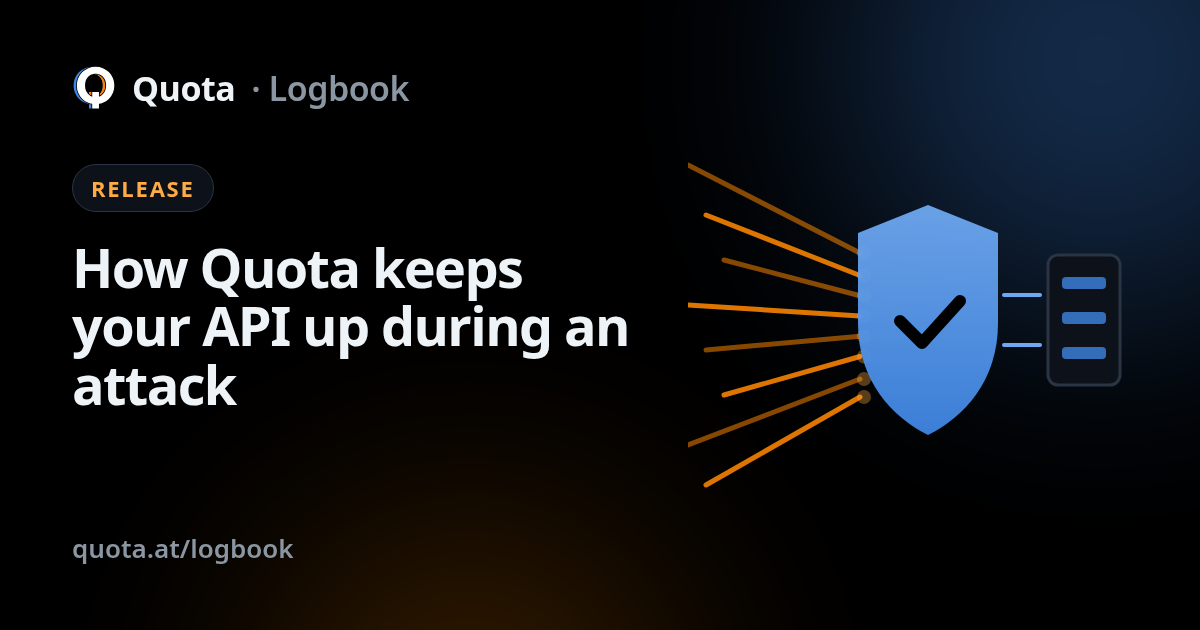
How Quota keeps your API up during an attack
What you see when someone floods your API behind Quota: the alert, defense mode in the panel, neighbours that keep serving, and the report when it ends.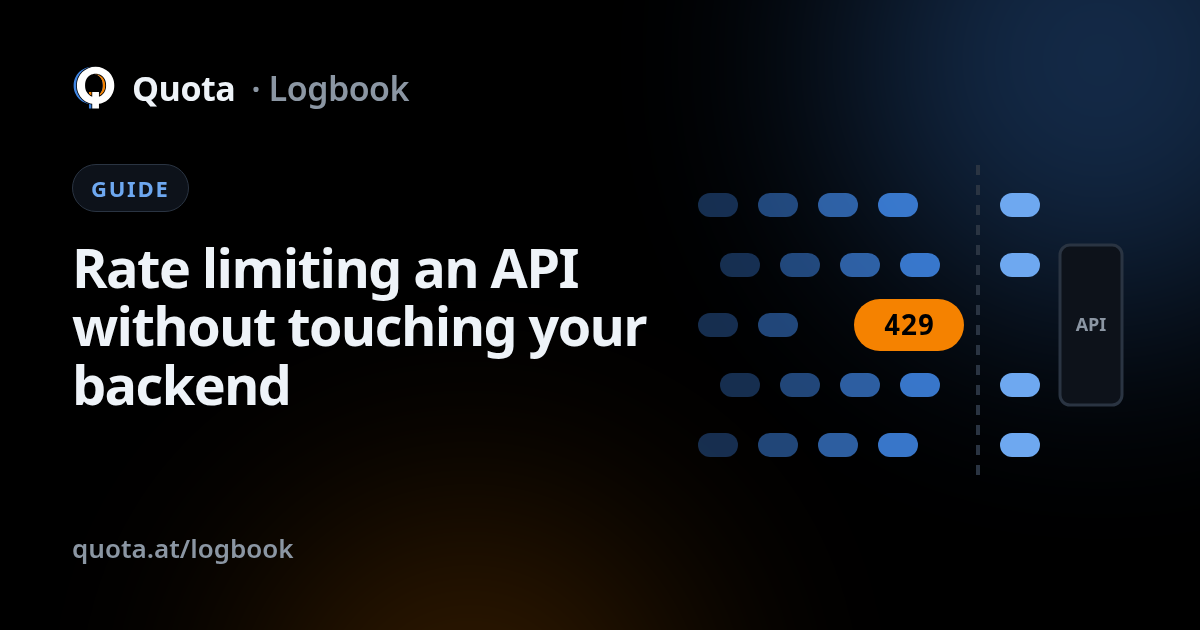
Rate limiting an API without touching your backend
Per-IP, per-route and global limits, what a 429 with Retry-After should tell a client, the usual mistakes, and why the edge is a better place for limits than your app.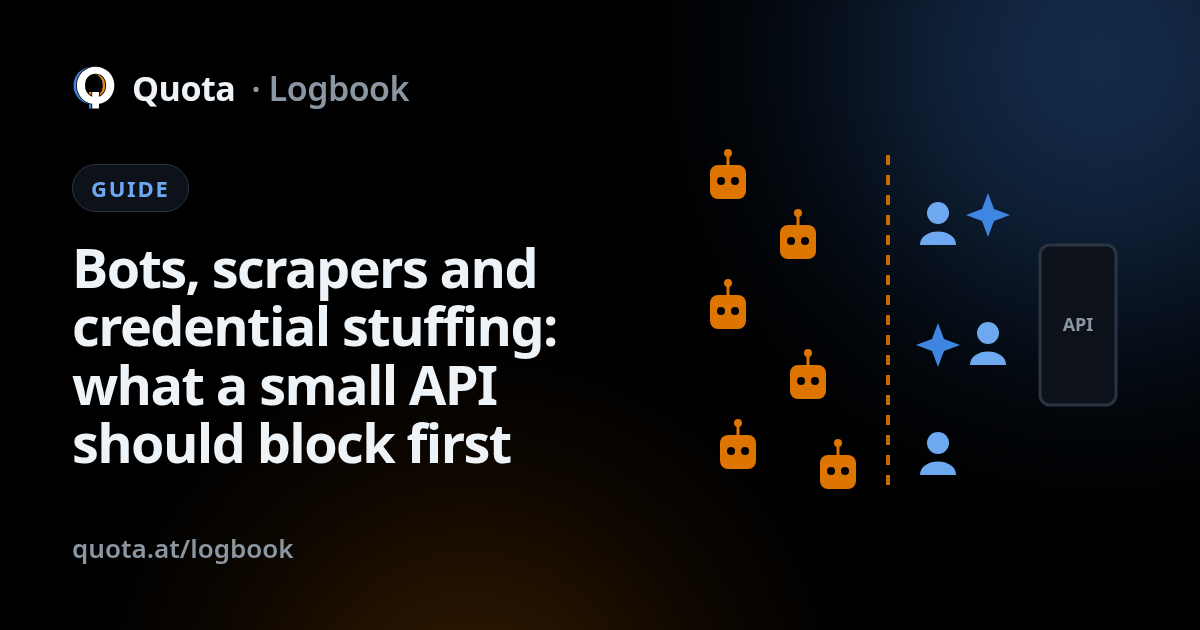
Bots, scrapers and credential stuffing: what a small API should block first
The automated traffic that hits small APIs first, how to recognise it from the outside, and which defences pay off before you have a security team.Changes
November 2026
· An attacked node is moved out of its neighbours' way. When an attack puts a node into defense mode and it shares its process with other nodes, we move it to a process of its own. Its neighbours keep serving as if nothing happened. Once the attack has been over for a while, it moves back.
· DPA at sign-up, paperwork as PDF. The data processing agreement is signed when you create your account. Owners download it as a PDF from their account, and every member can download the GDPR record.
· Block a visitor from Realtime. Open a request, block whoever sent it for an hour, a day, a week or for good. You never see their IP; the visitor ID is enough.
· Realtime. Every request on your node as it happens, on a map and in full: route, status, what the edge decided, latency. Starter and up.
· Change plan from the node, pay with Stripe. Upgrade or downgrade a node from its page, with what you pay today shown before you confirm.
· Defense mode. When an attack holds for twenty seconds, the node blocks the IPs behind it, puts an emergency ceiling on everyone else and emails you. A report follows when it ends.
· Your own domain. Serve a node from your own hostname with a CNAME and a TXT. Usage shows how much came through each entry.
· New panel and firewall editor. A redesigned panel, and firewall rules you build and preview in a visual editor. Reports download as PDF.
August 2026
· Reports by email. A monthly summary of your traffic, and another one the moment an alert fires. Retention split into three spans so the long view no longer depends on keeping everything.
· Per-node storage caps. Every node now has a hard ceiling enforced by the storage engine itself, so one busy tenant can never crowd out another.
· Endpoint detection. The edge learns your routes on its own; you set limits on what it found instead of typing paths.
· First European node. edge-eu-1 in production, with per-endpoint and per-client limits from the panel.